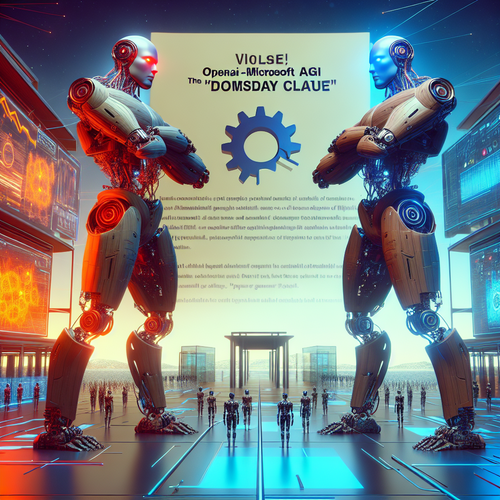
人工智能领域的两大巨头——OpenAI与微软,其合作关系正面临前所未有的考验。这场表面上的合作,实则暗流涌动,核心焦点在于对“通用人工智能”(AGI)的不同理解与潜在利益冲突。这不仅仅是一场技术路线之争,更是一场关乎未来AI霸权和经济利益的角逐,其结果将深远影响整个科技行业的走向。
The partnership between two giants in the field of artificial intelligence, OpenAI and Microsoft, is facing unprecedented challenges. What appears to be collaboration is in fact fraught with underlying tensions, centered around differing understandings of “Artificial General Intelligence” (AGI) and potential conflicts of interest. This is not just a debate over technological direction, but a battle for future AI dominance and economic stakes, the outcome of which will profoundly influence the trajectory of the entire tech industry.
这场冲突的核心在于双方在2019年签署的一项具有里程碑意义的条款,被形象地称为AGI“末日条款”。根据该条款,一旦OpenAI董事会认定其已创造出AGI——定义为“在大多数具有经济价值的工作上超越人类的高度自主系统”——OpenAI对微软的义务可能大幅减少。这为OpenAI提供了一条潜在的“退出”路径,而微软显然正竭力阻止这一条款被触发或被移除。
At the heart of this conflict lies a landmark clause signed by both parties in 2019, dramatically dubbed the AGI “doomsday clause.” According to this provision, once OpenAI’s board determines it has created AGI—defined as “highly autonomous systems that outperform humans at most economically valuable work”—OpenAI’s obligations to Microsoft could be significantly curtailed. This provides OpenAI with a potential “exit” route, a prospect Microsoft is clearly fighting desperately to prevent or have removed.
双方在AGI是否即将实现的判断上存在明显分歧。有报道称,OpenAI高层认为他们已接近这一里程碑,并有权根据合同善意地宣布。然而,微软首席执行官萨蒂亚·纳德拉公开表示,由一方“自我宣称”达到AGI是一个“毫无意义的基准”。这种分歧不仅关乎技术评估,更触及了巨大的财务利益和对未来AI发展的控制权。
There is a clear divergence in opinion regarding whether AGI is imminent. Reports suggest that OpenAI executives believe they are close to this milestone and are contractually entitled to declare it in good faith. However, Microsoft CEO Satya Nadella has publicly stated that a single party “self-claiming” AGI is a “nonsensical benchmark.” This disagreement is not merely about technical assessment; it touches upon massive financial interests and control over the future development of AI.
紧张关系不仅仅局限于AGI的定义和触发机制。消息显示,双方还在收入分成、OpenAI未来的潜在收购等多个方面存在争议。尽管OpenAI和微软发布了表示合作关系“长期且富有成效”并对未来“保持乐观”的联合声明,但内部人士透露,这更像是一场“艰难的谈判”,而非“公开战争”。甚至有传闻称,OpenAI曾考虑向反垄断监管机构举报微软,而微软则威胁退出谈判,足见局势之严峻。
Tensions are not limited to the definition and triggering mechanism of AGI. Reports indicate disputes also exist on multiple fronts, including revenue sharing and OpenAI’s potential future acquisitions. Although OpenAI and Microsoft have issued joint statements describing their partnership as “long-term and productive” and expressing optimism for the future, insiders suggest this is more like a “tough negotiation” rather than “open warfare.” There have even been rumors that OpenAI considered reporting Microsoft to antitrust regulators, while Microsoft threatened to withdraw from talks, highlighting the severity of the situation.
这场围绕AGI“末日条款”和控制权的暗战,无疑是当前科技界最引人注目的焦点。这不仅仅是两个公司之间的商业纠纷,它暴露了在通往AGI的道路上,技术理想与商业现实、控制权与开放性之间的深刻矛盾。无论最终结果如何,OpenAI与微软的这场博弈,都将为我们理解AI时代的权力结构、合作模式乃至潜在风险,提供一个极具价值的案例。未来,这对曾经紧密的伙伴将何去何从,全球都在拭目以待。
This subtle battle over the AGI “doomsday clause” and control is undoubtedly the most compelling focal point in the tech world today. It is more than just a business dispute between two companies; it exposes the deep contradictions between technological ideals and commercial realities, control and openness, on the path towards AGI. Regardless of the final outcome, the struggle between OpenAI and Microsoft will provide a highly valuable case study for understanding the power structures, collaboration models, and even potential risks in the age of AI. The world is watching to see what becomes of this once-close partnership.
发表回复